

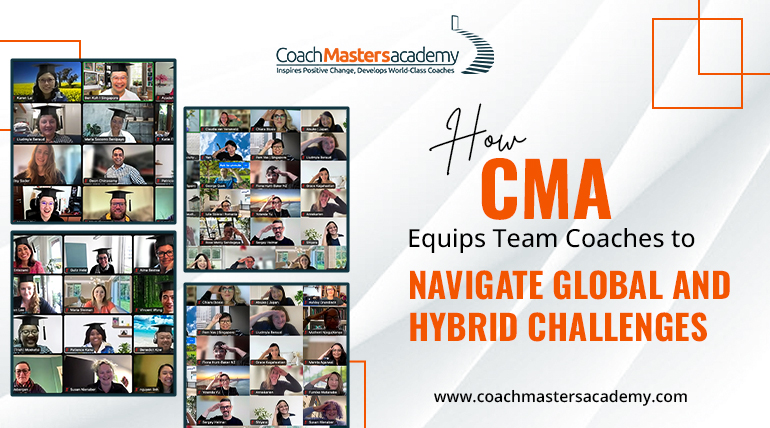
How CMA Equips Team Coaches to Navigate Global and Hybrid Challenges
18 Jul
How CMA Equips Team Coaches to Navigate Global and Hybrid Challenges
The reality of team coaching has significantly shifted in recent years. Coaches no longer work with teams operating within a single office, culture, or time zone. Instead, they are increasingly guiding teams that span continents, operate across hybrid setups, and are shaped by a diversity of worldviews, communication styles, and work cultures. This new normal demands a deeper, more systemic approach to coaching, one that moves beyond surface-level cohesion to real, sustained alignment and performance.
At the heart of meeting this complexity is the methodology and framework offered by Coach Masters Academy through its globally recognized Team Coaching Certification. Their emotionally intelligent and evidence-based approach prepares coaches to hold space for multiple realities, adapt across cultural nuances, and create clarity where ambiguity dominates.
Understanding Complexity in the Team Coaching Landscape
Coaching a team is not simply a scaled-up version of coaching individuals. When working with globally dispersed or hybrid teams, the challenge amplifies further. Differences in decision-making styles, language fluency, power distance, pace, and even time zone sensitivities can turn simple alignment tasks into prolonged friction points.
Team coaches are often brought in when communication has broken down or when trust is faltering, not because of individual dysfunction, but because of the larger system in which those individuals operate. Hybrid and cross-cultural environments add an invisible layer of complexity. Coaches who are not equipped to recognize and navigate these systemic challenges can easily fall into tactical interventions that miss the deeper currents shaping team behavior.
The Team Coaching Course at Coach Masters Academy helps practitioners reframe these challenges as opportunities. It equips them with tools to coach the whole system, holding the team as the client, while developing the capacity to observe, reflect, and intervene without bias.
The Role of Emotional Intelligence in Hybrid and Cross-Cultural Coaching
One of the most critical skills in navigating team complexity is emotional intelligence, not just at the individual level, but applied systemically. Hybrid teams, for instance, face an uneven playing field when it comes to visibility, access, and influence. Remote team members may feel excluded from informal decision-making loops, while on-site members may misinterpret silence as disengagement. Similarly, cross-cultural teams may operate with different norms around conflict, feedback, or collaboration.
The Team Coaching Program at Coach Masters Academy centers emotional intelligence as a foundational skill. It helps coaches cultivate presence, empathy, and attunement, allowing them to sense undercurrents even when the data is fragmented. Through guided practice, coaches learn to listen not just to what is being said, but to what is left unsaid. They develop the ability to hold difference without judgment, creating the kind of psychological safety required for collective insight and transformation.
By integrating emotionally intelligent coaching practices, team coaches can bring unconscious group dynamics into awareness, helping teams see how they operate together, not just how each member performs individually.
Applying the Awareness–Clarity–Choice™ Framework in Complex Teams
Global and hybrid teams rarely struggle from a lack of ambition. What they often lack is shared clarity, on direction, roles, or even the meaning of success. Misalignment is rarely malicious; it is simply a byproduct of different frames of reference. Coach Masters Academy addresses this through its proprietary Awareness–Clarity–Choice™ framework, a key feature of its Team Coaching Certification.
The model guides team coaches to first help teams become aware of their underlying assumptions, patterns, and emotional tone. From there, the work shifts to creating clarity, not in the abstract, but in the operational. Clarity on what matters, who holds responsibility, what pace is realistic, and how trust is maintained when expectations vary.
Finally, the framework culminates in generating authentic choice, action that emerges not from compliance or urgency, but from shared ownership. This methodology is especially useful in hybrid environments where alignment cannot be taken for granted and where team cohesion must be actively cultivated.
Coach Masters Academy trains team coaches not just to facilitate conversations, but to design learning spaces where teams can make meaningful, system-wide shifts in how they think, feel, and act together.
Coaching the Space Between Team Members
Experienced team coaches understand that the true work happens not just within the individuals on the team, but in the relational space between them. In hybrid and multicultural contexts, this space is even more charged, with potential for both conflict and innovation.
The Team Coaching Course encourages practitioners to develop the sensitivity and range to work within this space. It offers practice in real-time group reflection, reframing, and systems sensing. Coaches are guided in how to help teams name the ‘undiscussables’, those tensions that silently shape interaction, and then navigate them without defensiveness.
Coaches learn to facilitate dialogue that honors cultural diversity while drawing teams toward a unified vision. They become skilled at working with the group’s collective intelligence, helping the team access wisdom that no one individual alone could offer. This is what sets apart transactional facilitation from transformational coaching, and it’s what the Coach Masters Academy equips its certified team coaches to consistently deliver.
Building Long-Term Coaching Impact in Global Organizations
For team coaches working with international organizations or fast-scaling hybrid companies, it’s no longer enough to coach for short-term behavioral shifts. Organizations today demand sustainable change, change that sticks long after the coach steps away. The Coach Masters Academy team coaching program is designed to support this long-term impact.
Through a structured curriculum and guided practice, coaches learn how to design coaching engagements that embed learning into the team’s operating rhythm. They gain the skills to facilitate milestone reviews, embed reflective practices, and co-create accountability structures that sustain progress.
More importantly, the program prepares coaches to adapt, not by abandoning their core principles, but by deepening their flexibility, cultural literacy, and ability to work with complexity without losing direction.
Final Thoughts
Global and hybrid team environments are not temporary trends, they represent the new landscape of collaboration. For team coaches who want to lead meaningfully in this space, it requires more than tools or techniques. It calls for a grounded, emotionally intelligent, and systemic approach to coaching that helps teams move from fragmentation to cohesion.
Coach Masters Academy offers precisely this kind of depth through its ICF-accredited Team Coaching Program. By integrating the Awareness–Clarity–Choice™ framework with real-world application, it prepares coaches to hold space for meaningful transformation, wherever the team may be located, and whatever complexity they may face.
For those committed to elevating their coaching practice in service of powerful, aligned, and high-performing teams, this is the foundation that creates lasting impact.