


Existential Approach to Engage the Whole Person

Existential Approach to Engage the Whole Person

by Dr Ben Koh, Master Certified Coach, Global Top 50 Coaches
Founder of Coach Masters Academy


Coaching at a Turning Point

Coaching now occupies a significant place in leadership, professional development, education, and organisational life. It is called upon when people are under pressure, facing transition, carrying greater responsibility, or discovering that competence alone is no longer enough. Yet the field now stands at an important threshold. If coaching is to remain consequential in the years ahead, it must become clearer about what only coaching can uniquely offer.

That contribution cannot be reduced to technique. Frameworks, models, diagnostics, and behaviour-change methods remain useful, but they no longer capture the profession’s deepest value. The most important coaching conversations often begin where information is not the problem, and where advice, however sensible, does not reach the real issue. A leader may know exactly what should be done and still feel unable to do it. A capable professional may continue to perform and yet feel inwardly estranged from their own work. A person may ask for greater confidence when what is really being asked of them is courage.

This is where coaching must widen its lens.

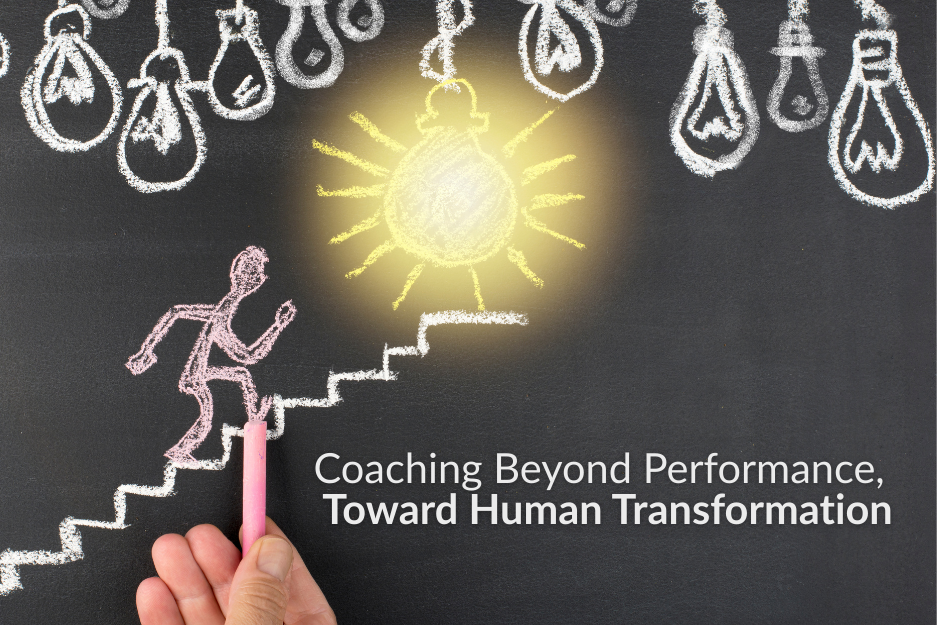
“Existential” doesn’t mean bleak or abstractly philosophical. It refers to fundamental human questions: meaning, freedom, uncertainty, relationships, and how we choose to live. An existential orientation allows coaches to engage these realities directly. A transformational approach ensures that this insight doesn’t just stay in the mind—it becomes embodied and enacted. Together, they move coaching past performance repair and into generative change.


When the Issue Beneath the Issue Begins to Speak

Many engagements begin with practical concerns: handling conflict, regaining motivation, or stopping the cycle of overwork. These are valid starting points. Yet, the presenting issue is rarely the whole story—it’s usually the surface expression of a deeper struggle.

Indecision may not be a lack of judgment, but a fear of consequences. Overwork might reflect more than poor boundaries; it can be a life organised entirely around proving one’s worth. Conflict avoidance often stems from a deep-seated need to be liked or remain beyond criticism. Even burnout is misunderstood if treated simply as exhaustion, rather than the collapse of a lifestyle that has lost its connection to meaning.

When coaching stays at the symptom level, it offers isolated corrections. It polishes the visible pattern while leaving the root structure intact. The client might function better temporarily, only to face the same difficulty in a new disguise.

True depth begins when the coach gets curious about the issue beneath the issue. The central question shifts from, “How do we fix this behaviour?” to, “What way of living keeps recreating this problem?” That is the exact moment coaching evolves from efficient adjustment into genuine inquiry.


From Symptom to Structure

A pivotal shift in serious coaching is moving from symptom to structure. Symptoms are what clients readily name: hesitation, perfectionism, fatigue, and self-doubt. Structure is the underlying architecture generating these patterns—our habitual interpretations, emotional reflexes, physical responses, and long-standing self-assessments.

People don’t just react to events; they live inside interpreted worlds. One person sees a challenge as an invitation; another feels exposed. One hears feedback as data; another hears it as an indictment. The outer circumstances are identical, but the inner world experiencing them is vastly different.

Our most important skill is observing how people construct their reality. Before meaningful change can happen, people must notice what has always felt automatic.

What is being assumed?
What silent conclusion has already been drawn?
What becomes impossible the moment that conclusion is accepted?
What identity is being protected?
What loss is being avoided?

Such questions are not ornamental. They expose the architecture of experience. They help people recognise that what has felt like fate may, in part, be an interpretation, an adaptation, or an unfinished history. Once that recognition becomes real, the field of possibility begins to widen.


Anxiety, Meaning, and Choice

An existential lens offers a more mature approach to discomfort. Today’s culture often treats anxiety as a pest to be managed, reduced, or reframed. But anxiety isn’t always a symptom of dysfunction; often, it signals that something deeply important is at stake.

Honest choices are inherently unsettling. They force us to face uncertainty, consequences, and loss. A truthful path might disappoint others, require shedding a protected identity, or demand speaking a truth we’ve long deferred. Growth doesn’t always show up as confidence—often, it feels like raw exposure.

Questions of meaning demand the same gravity. A person can function perfectly well long after their sense of meaning has eroded. Fueled by momentum, discipline, or sheer competence, they look fine from the outside. Inside, something essential has gone quiet. In these moments, offering productivity hacks or motivational pep talks feels painfully hollow.

What’s needed is a conversation about allegiance, purpose, and truth. Not just “What do you want?” but “What kind of life are you currently participating in?” Existential work honours emptiness and tension as signs that a person is standing at the edge of a more honest life.


What Generative Change Actually Means

The distinction between change and generative change is crucial. A person can alter their behaviour without touching its source. They can become more disciplined or resilient, yet remain driven by the same fear or narrow narrative. When the pressure spikes, the old pattern returns because their core hasn’t shifted.

Generative change doesn’t just produce new behaviours; it builds new capacity. It rewires how a person interprets their world, takes responsibility, and acts. The observer themselves changes.

The impact is profound. What once felt mandatory begins to loosen. The impossible becomes thinkable. This isn’t just cognitive. People might realise their competence was masking fear, or their relentless striving was a shield against vulnerability. When these realisations move from the head to the heart, they alter how a person stands in the world. This is the bedrock of generative change: the emergence of a more truthful way of being.


The Transformational Approach: Turning Insights Into A Change Catalyst

If an existential orientation clarifies what is really at stake, a transformational approach provides the means by which that clarity becomes lived change. Insight alone, however refined, rarely reshapes a life. Many people can describe their patterns with impressive sophistication while continuing to enact them. Understanding matters, but it must become embodied to become consequential.

This is how our transformational coaching achieved this.

Through language. We live inside conversations that define what’s possible. “I must not fail.” “I’m only safe when I’m indispensable.” These internal declarations don’t just describe a world; they build it. We must listen acutely to how people linguistically construct their reality, helping them author a new one.

Through emotion. Resignation shrinks the future. Resentment distorts the connection. Grounded seriousness, however, opens new horizons. We aren’t just addressing what a client thinks, but the emotional climate housing those thoughts.

Through action. New ways of being must be field-tested. A truth is spoken. A boundary is held. A role is dropped. These aren’t just homework assignments; they are the literal acts of a new self taking form.

The transformational approach isn’t an accessory to existential coaching; it’s the engine. Without it, insight is just elegant theory.


What Does This Demand of a Coach Practitioner

This understanding raises the standard of coaching practice. It asks more of the coach than just technical proficiency. Method remains important, but our way of being matters as well.

A Coach Practitioner working at this level must be able to stay with ambiguity, contradiction, grief, defensiveness, and silence without fleeing into premature advice or excessive reassurance. People often protect themselves through fluency, busyness, charm, abstraction, or compliance. To hear beneath those forms without humiliating the person who depends on them requires tact, steadiness, and discernment. It also requires courage. There are moments when the coach must name what is becoming visible, even when doing so unsettles the client’s preferred account of the situation.

The coaching relationship becomes a place where people is neither managed nor indulged, but genuinely met. To be met in this way is itself developmental. It gives people an increasingly rare experience: being addressed as someone capable of truth, freedom, and responsibility.

For the profession, the implications are equally significant. Coaching education cannot depend solely on the accumulation of models. It must include formation in perception, language, embodiment, relational maturity, and the disciplined capacity to work with uncertainty. Supervision must take depth seriously. Organisations, too, will need to decide whether they want coaching merely as a performance accessory or as a space where meaningful human development can actually occur.


Toward a More Human Practice

Our profession is entering an era where its authority will be tested by abundance. Frameworks are replicable. Techniques can be automated and scaled. What cannot be commodified is the deeply human capacity to sit with another person in the messy, difficult territory where meaning, identity, and change collide.

Coaching is at its absolute best when it helps people do more than solve problems efficiently. It helps them see truthfully, choose responsibly, and participate fully in the lives they are shaping. In a world saturated with quick advice, our true value lies in helping people become honest participants in their own existence.

That is why an existential orientation matters. It brings to light the human questions that lie beneath performance: meaning, freedom, anxiety, responsibility, relationship, identity, and finitude. It enables coaching to address not only what a person should do next, but how that person is living and who that person is becoming.

That is also why a transformational approach is indispensable. Human beings do not change deeply through insight alone. They change when insight alters what they can say, what they can bear, how they can stand, and the future they are prepared to create.

If coaching is to become more vital in the years ahead, it will do so not by narrowing itself to technique, but by recovering confidence in this deeper task. In a world saturated with advice, its distinctive value will lie in helping people become more truthful authors of their own lives.


If coaching is to help people become more truthful participants in their own lives, then it must also learn when helping too quickly can do harm. “When Helping Hurts” explores this with clarity and force, showing why understanding must come before intervention if change is to be truly transformational.

Leave a Reply

Your email address will not be published. Required fields are marked *