

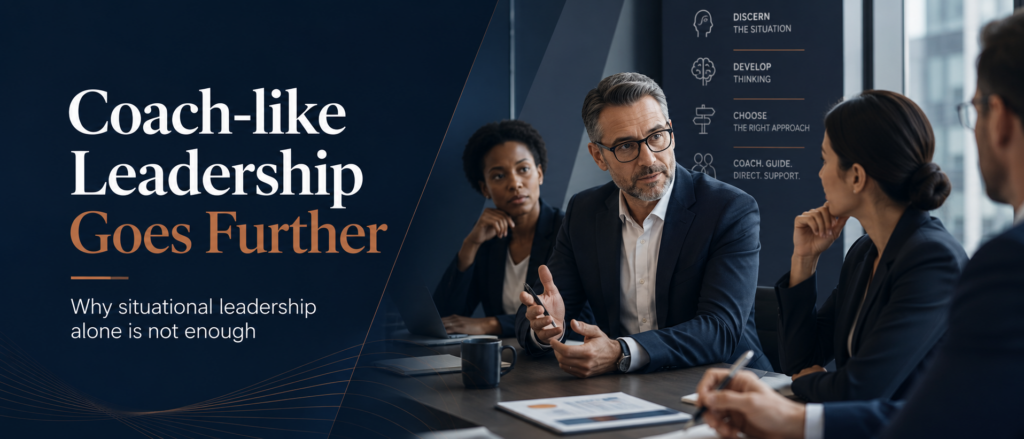
Coach-like Leadership: Why Situational Leadership Needs to Go Further

Coach-like Leadership: Why Situational Leadership Needs to Go Further

At Coach Masters Academy, we believe workplace leadership must be measured by more than whether people deliver results. It must also be measured by what happens to people’s capacity to contribute as they do the work.

This matters because organisations increasingly expect people to take initiative, exercise judgment, work through uncertainty, and carry greater responsibility. Yet many managers still lead as though their primary role is to provide answers, monitor progress, and step in whenever someone struggles.

The contradiction is difficult to ignore: organisations ask for mature contribution while leadership habits often cultivate dependence.

Situational Leadership has remained influential because it begins with an important insight: people do not need the same form of leadership in every circumstance. Someone new to a responsibility may need clear guidance. Someone with experience but limited confidence may need encouragement, discussion, and support. Someone highly capable may need room to exercise their judgment.

Its coaching style sits between directing and delegating. The leader offers clarity while remaining supportive and involved. Yet, in many workplaces, this becomes little more than a more personable form of supervision: explain the task, check in regularly, encourage the person, and remain close enough to correct errors.

That may help someone complete the task at hand. It does not necessarily prepare them to meet the next challenge with greater confidence, discernment, and responsibility.

This is why Coach Masters Academy advances Coach-like Leadership.

Coach-like Leadership extends the coaching style within Situational Leadership through the wider developmental ambition of Transformational Leadership. It asks leaders to respond to what a person needs in the present while strengthening their ability to contribute in the future. The immediate work matters. So does what the person is learning about responsibility, decision-making, and their own capacity to work through complexity.

The difference may sound modest. In daily leadership, it is consequential.

When Help Creates Dependence
Many leaders are genuinely helpful. They are accessible, responsive, and willing to step in. But helpfulness becomes unhelpful when the leader becomes the answer to every difficult question.

When every important decision returns to the manager, people learn to wait. When leaders solve problems before asking what the individual has already considered, people learn that their thinking is secondary. When leaders repeatedly protect people from the consequences of poor planning or hesitant judgment, they may preserve short-term delivery while weakening long-term responsibility.

The issue is not whether leaders should help. It is whether their help enables people to become more capable—or makes them increasingly reliant on the leader.

Coach-like Leadership asks leaders to make this distinction. There are moments when direct guidance is necessary: when expectations are unclear, risks are high, or someone is learning the fundamentals. But there are also moments when the most useful response is not another answer, but a conversation that expects the person to assess the situation, form a view, and take responsibility for a next step.

A leader might say:

“This is the outcome we need, and these are the boundaries we need to work within. How do you understand the issue? What options have you considered? What is your recommendation?”

This is not a conversational trick. It communicates a clear expectation: your thinking matters here, and you are expected to use it. The leader remains responsible for standards and, where necessary, the final decision. But the individual is no longer treated as merely the executor of someone else’s judgment.

Accountability That Builds Capacity
Workplace leadership often narrows people to performance: are they delivering, meeting expectations, and demonstrating competence? These questions are legitimate. Standards matter, and accountability cannot be avoided.

But performance is not the whole picture.

A person may meet targets while becoming increasingly dependent on approval. They may complete tasks while losing trust in their own judgment. They may appear compliant while withholding concerns or perspectives their team needs to hear.

Coach-like Leadership holds performance and development together. It addresses what must be delivered while recognising that everyday work shapes how people respond to challenge, ambiguity, failure, and responsibility.

When a deadline is missed, the impact should be named and the expectation clarified. Yet the conversation need not end with correction. A leader can ask:

“What did you not see early enough? What made it difficult to raise this sooner? What will you do differently when you face this again? What support do you need—and what is yours to take responsibility for?”

These questions do not weaken accountability. They make it more substantial. Instead of simply receiving an instruction or warning, the person examines what happened, identifies what must change, and makes a commitment they can carry forward.

The Coach Masters Academy View
At Coach Masters Academy, we see coaching competencies as essential leadership capabilities—not as a set of techniques to be performed, and not as a substitute for leadership authority.

They enable leaders to listen before concluding, to ask questions that sharpen thought rather than avoid difficult issues, to give direct feedback without being dismissive, and to offer support without taking over. They help a leader judge when to provide direction, when to invite reflection, when to challenge, and when to give someone room to act.

This is where Transformational Leadership gives Coach-like Leadership its wider purpose. Leadership is not only concerned with the completion of work. It is concerned with whether people can recognise the significance of their contribution, bring their thinking to what they do, and become more able to carry responsibility over time.

Coach-like Leadership gives this purpose a place in ordinary work: in the project review, the difficult feedback conversation, the missed deadline, the emerging leader’s uncertainty, and the moment someone comes to the manager asking, “What should I do?”

The leader’s response in these moments shapes more than the immediate outcome. It teaches people whether they are expected to wait for answers or develop sound judgment; whether mistakes must be concealed or can be faced honestly; whether responsibility is imposed from above or carried with growing maturity.

A More Exacting Standard
Coach-like Leadership does not ask managers to become professional coaches. Nor does it suggest that every situation should be met with questions and reflection. Leaders must still decide, direct, set boundaries, and act quickly when circumstances require it.

Its proposition is more fundamental: leadership should be judged not only by whether work is completed, but by whether people become more able to think, decide, speak up, and carry responsibility as the work is completed.

Situational Leadership teaches leaders to respond to the person and circumstances. Transformational Leadership directs attention to purpose and development. Coach-like Leadership brings these together through leadership behaviours strengthened by coaching competencies.

This is the leadership practice Coach Masters Academy seeks to cultivate: leaders who do not merely help people get through today’s work, but who leave them more capable of meeting tomorrow’s work without needing every answer to come from the leader’s desk.

Leave a Reply

Your email address will not be published. Required fields are marked *