“Self-care” has become both popular and controversial. Some people hear it as maturity; others hear it as softness. Meanwhile, everyday life is getting heavier: faster change, more comparison, more decisions, and less mental breathing room. This article offers a reframing that keeps depth without becoming abstract. It argues that the real issue isn’t self-care versus discipline, but fragility versus attunement—the ability to notice what matters and adjust wisely. It also suggests that “balance” is a weak metaphor for modern life because it implies a stable ratio in a world that keeps moving.
In its place, the article introduces harmonising: composing a coherent way of living under constraints. To make this practical and relatable, it draws wisdom from fine cuisine—where preparation, restraint, timing, and “tasting as you go” turn pressure into craft. The article closes with concrete practices and coaching prompts that help people build sustainable growth without losing their humanity.
A strange tension sits inside many of us. We admire people who push their limits, and we also fear burning out. We want to be strong and feel whole. The language of self-care often lands in the middle of that conflict. For some, it signals wisdom and self-respect. For others, it sounds like an excuse—an invitation to avoid discomfort.
At the same time, the pressure is real. Life is not only busy; it is mentally demanding. Notifications compete with attention. Expectations multiply. Learning never seems to end. Even when we’re not working, our minds are often still “on.”
This article proposes a shift that can change how we interpret both self-care and growth. The shift is from balancing to harmonising. Balancing is useful for time management, but it struggles as a life philosophy because it assumes we can reach a stable equilibrium. Harmonising is different: it is a craft of adjusting in motion—choosing the right mix of effort, rest, courage, and care for the moment you are actually in.
When people criticise self-care, they often mean: “We’re getting fragile.” That concern isn’t imaginary. Avoidance can disguise itself as well-being. Comfort can become a cage.
But there is another kind of “softness” that is not fragility at all: sensitivity—the ability to notice early signals before they break down. Sensitivity is not the opposite of strength. It’s the raw material of wise action. In complex lives, numbness isn’t toughness; it’s blindness.
Likewise, “hardness” comes in two forms. One is courage: staying with difficulty for the sake of what matters. The other is callus: shutting down feelings and complexity to keep performing. Callus can look impressive until it quietly damages judgment, relationships, and ethics.
So the real question isn’t “Should I practise self-care?”
It’s: Is my self-care helping me stay awake to life—or helping me escape it?
And equally:
Is my discipline building my capacity—or eroding it?
“Balance” suggests a scale: equal weights, a stable ratio, a life you can keep level. It’s a comforting image—and often a frustrating one.
Real life is seasonal. Some weeks demand intensity. Some seasons demand recovery. Some days you need courage; other days you need care. When we treat balance as a permanent state, we turn normal fluctuation into personal failure: “I’m not balanced, so I’m doing life wrong.”
There’s another problem: many of the tensions we navigate aren’t simple trade-offs. They’re values that matter at the same time—honesty and kindness, ambition and health, boundaries and belonging. These cannot be solved with a fixed formula. They require judgment.
Balance can still help you schedule. But it rarely teaches you how to live when conditions change. For that, we need a different metaphor.
Harmony is not the absence of tension; it is a meaningful relationship between tensions. In music, harmony can include dissonance. What matters is whether the whole becomes coherent—whether the movement makes sense.
In everyday life, harmonising means learning to adjust without falling into extremes. It relies on attunement: a trained ability to notice what is happening (internally and externally) and respond with fit, not reflex.
This is a revolutionary shift because it changes the goal. The goal is no longer “keep everything equal.”
The goal becomes: compose a coherent life under real constraints.
That sounds lofty until we name the constraints plainly: time, attention, energy, emotional bandwidth, and the limits of what one human can carry.
A word that deserves more respect is finitude. It means a simple truth: human beings are limited. We have limited attention. Limited energy. Limited patience. Limited emotional capacity. Pretending otherwise can look like ambition, but it often becomes a quiet form of self-violence.
Many people suffer under an unspoken fantasy of infinite responsibility: “If I’m good enough, I should be able to handle it all.” This fantasy is not only unrealistic; it can be ethically dangerous. It tempts us to override our signals, neglect our relationships, and make short-term choices that cost us later.
Harmonising begins when we stop treating limits as weaknesses and treat them as design constraints. That leads to one uncomfortable but liberating insight:
A coherent life requires the courage to disappoint.
You cannot say yes to everything and remain whole. You cannot meet every demand and still have depth.
A common response to modern pressure is: “Just learn faster.” Adaptability matters. Learning matters. But there is a hidden drain when we live in always-on learning—constant upskilling, constant updates, constant improvement.
Learning is not only about absorbing information. It also requires digestion: reflection, consolidation, and time for meaning to form. Without digestion, we can become “competent on the surface, thin underneath”—quick to respond, slower to understand, easily overwhelmed by complexity.
This is why rest isn’t merely recovery from work. Rest is also a recovery of judgment. Harmonising protects the mental space where wisdom grows.
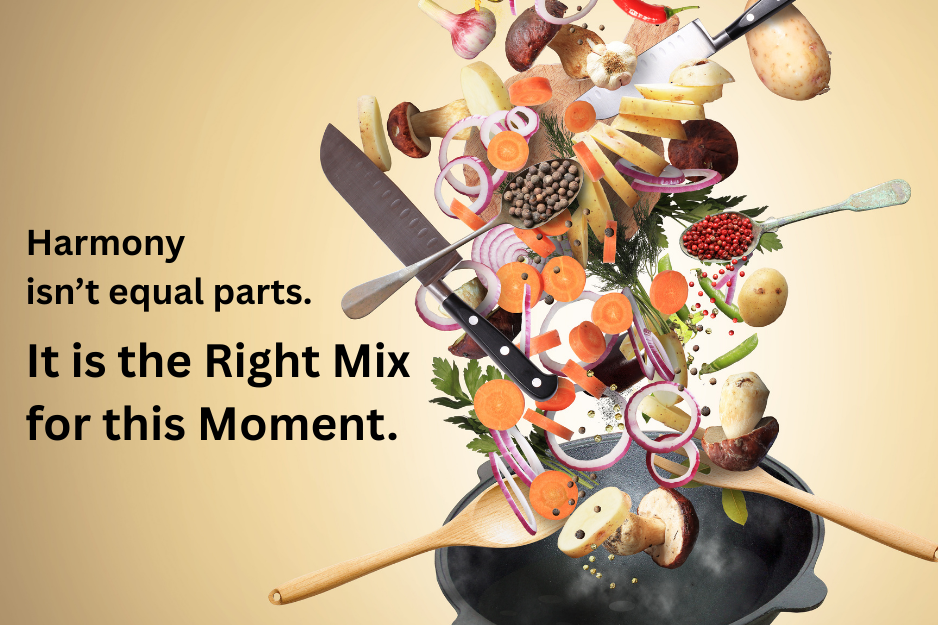
If you want a practical model of harmonising under pressure, look at a chef in a serious kitchen. Great cooking is not just skill—it is disciplined creativity under constraints. It’s also a form of attention: to ingredients, timing, heat, and the moment.
Here are the transferable lessons, in everyday language:
Prepare before the rush
Chefs don’t improvise everything at the stove. They set up first—ingredients ready, tools ready, station clear. In life, this is the difference between reacting and choosing.
Know your “ingredients”
A chef doesn’t treat every tomato the same. In your life, the “ingredients” include your energy patterns, relationships, obligations, and environment. Harmonising starts by noticing what you’re actually working with.
Control the heat
Some things need high heat (a decisive action, a brave conversation). Some things need simmering (learning, healing, complex decisions). Constant high heat burns people; constant low heat stalls life. The art is switching intentionally.
Practise restraint
When uncertain, many cooks add more. Many people do the same: more commitments, more tools, more plans. But refinement often comes from subtraction.
Taste as you go
Chefs adjust continuously. They don’t wait until the dish is served to discover it’s off. A harmonised life relies on small feedback loops, not dramatic reinventions.
Bring your presence to the moment
In cooking, attention changes outcomes. In life, the quality of your attention changes your next sentence, next decision, next relationship move.
Below are compact practices designed for general readers and useful for coaches.
Weekly set-up (10 minutes)
What matters most this week?
What can wait without guilt?
What am I avoiding that is quietly draining me?
Coaching prompt: “What would a ‘good week’ look like emotionally, not just productively?”
Heat setting (daily, 1 minute)
What needs high heat today? (choose one)
What can simmer?
Coaching prompt: “Where are you using urgency to avoid fear or uncertainty?”
Subtraction move (daily, 2 minutes)
Remove one small drain: a commitment, a habit, a conversation you keep postponing, a default “yes.”
Coaching prompt: “If you stopped doing one thing, what would improve immediately?”
Taste test (end of day, 3 minutes)
What felt off today—too much, too little, out of rhythm?
What one adjustment will I make tomorrow?
Coaching prompt: “What is your system trying to tell you before it has to shout?”
The 30-second pause that changes your next sentence
Before a difficult moment, pause and name:
What am I trying to protect or create?
What’s the easiest unwise move here?
What tone does this moment need from me?
This is “presence” made practical: not mystical, not perfect—just a short reset toward fit and clarity.
One more provocation: if your life is structurally overloaded, “self-care tips” can become a form of blame. No amount of meditation can fix an impossible schedule. Harmonising isn’t only personal; it is relational and systemic. It includes renegotiating expectations, redesigning workload, and building relationships where honesty is safe.
For coaches, this means listening for the difference between an internal pattern (perfectionism, avoidance) and an external constraint (unrealistic demands, unstable environment). Sometimes the growth edge is inner courage. Sometimes it is an outer redesign.
The future doesn’t belong to the people who simply endure. It belongs to people who can compose coherence under pressure—who can move between effort and recovery without swinging into extremes, who can respect finitude without shrinking, and who can practise courage without becoming calloused.
Balance is a tool. Harmonising is a way of living. It replaces guilt with craft: preparing before the rush, controlling the heat, subtracting what clutters, tasting as you go, and showing up with enough presence to choose wisely.
In an accelerating world, this is not softness. It is a mature form of strength: the strength to stay awake, stay human, and still grow.
Dr Ben Koh, Founder of Coach Masters Academy
Master Certified Coach I Global Top 50 Coaches


Leave a Reply