by Dr Ben Koh, Founder of Coach Masters Academy I Master Certified Coach I Global Top 50 Coaches
Expert in transformational coaching psychology and reflective development.
Abstract: This article examines a coaching moment in which a client recognised the source of his fear, yet could not engage in the deeper encounter required for change. It uses this moment to explore the mind’s protective architecture, the developmental gap between knowing and becoming, and the nature of reflective learning. A discourse on the coaching mindset is presented, followed by an introduction to the CMA Coaching Transformational Mindset — a cognitive posture oriented toward identity-level work. Positioned at the intersection of coaching psychology and reflective development, this article advances the conversation on what contemporary coaching now requires.
This article builds upon the companion blog, “Why You Are Stuck: Your Mind Is Trying To Protect You.” While the blog offers an accessible entry point, this piece deepens the theoretical discussion for practitioners and readers interested in reflective development. The blog and this article are designed to complement one another.
Fear often presents as the primary issue in coaching, yet it is rarely the real barrier. In a recent session, a client recognised that his fear was tied to a future possibility rather than a present threat. He articulated the needs beneath it — stability, safety, competence — and expressed a desire to trust himself more. Yet whenever the conversation approached the deeper structure of the fear, he instinctively shifted toward wanting to eliminate it.
This moment highlights a central paradox in transformational work:
People may understand their patterns yet remain unable to access the deeper encounter that creates lasting change.
The sections that follow use this moment as a window into the mind’s protective logic, the demands of reflective learning, and the evolving expectations placed on practitioners.
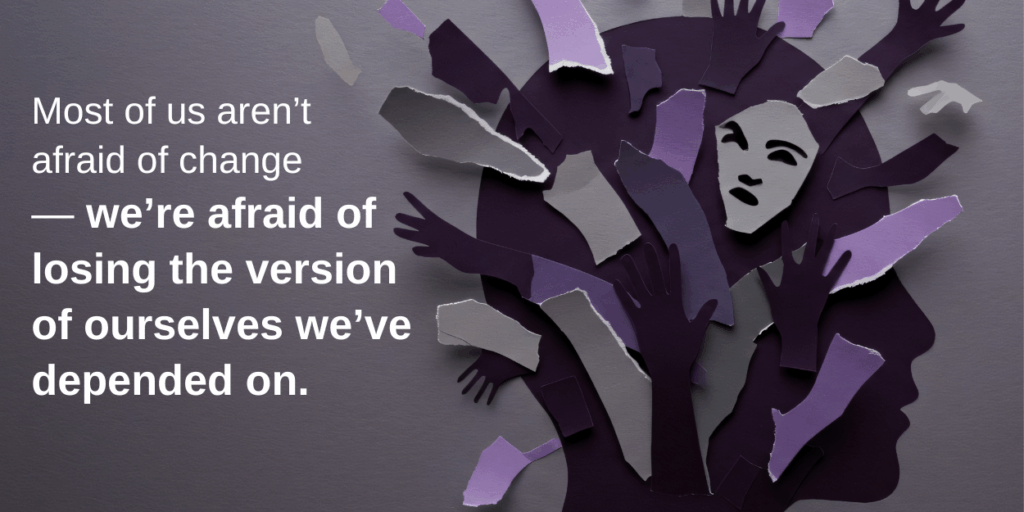
The client’s avoidance was not resistance but protection. The mind’s instinctive role is to maintain continuity — to hold in place the meaning structures that once stabilised identity and created safety.
A key insight becomes clear:
Insight lives at the surface; protection lives beneath it.
Individuals may recognise their patterns yet remain unable to examine the deeper commitments their fear defends — commitments tied to identity, adequacy, belonging, and personal expectations about who they must be.
Understanding this protective logic reframes the behaviour. The mind is not hindering development; it is honouring meanings that once made life coherent.
Recognising this dynamic sharpens the coaching mindset. When a client’s internal world is protecting old meanings, the practitioner’s stance determines whether deeper exploration becomes possible.
A mindset grounded in presence, patience, and curiosity signals safety to the client’s inner world. It communicates that there is no urgency to resolve — only an invitation to see. This loosens defensive reflexes and creates the conditions for reflective depth.
This mindset is not a set of techniques. It is an internal orientation that shapes how the practitioner holds and interprets the client’s experience.
Many clients can articulate their patterns. Far fewer can inhabit the insight.
Between knowing and becoming lies an interior gap — a psychological threshold where transformation takes shape.
Within this gap, people often:
This gap is not a limitation. It is the terrain of adult development.
Here, coaching becomes essential. The practitioner’s grounded presence allows the client to stay with the experience long enough for new meaning to emerge. Transformation begins not at the moment of insight but when insight starts to reorganise the client’s inner world.
Stepping into the client’s experience after the learning becomes available reveals a more coherent picture. The fear is purposeful. It safeguards commitments:
to being capable,
to meeting internal expectations,
to maintain valued roles,
to protecting worth and belonging.
From this perspective, fear becomes understandable. It is neither irrational nor obstructive — it is loyal.
The deeper realisation emerges:
Fear softens when we understand what it’s guarding — and that understanding begins when we stop fighting it.
This marks the beginning of inner reorganisation.
Reflective learning challenges the mind’s preference for efficiency and certainty. It requires individuals to slow down, remain with ambiguity, and question interpretations that have gone unexamined for years.
This work engages:
The difficulty is not a barrier; it is the signal that the work is touching material with transformative potential. Reflective learning is not about correcting the mind but partnering with it until deeper coherence emerges.
These insights redefine the expectations of contemporary practitioners. Clients often bring self-awareness and psychological vocabulary. What they cannot reliably access is the deeper organisation of their inner world.
This is where the practitioner’s value lies.
Your relevance is no longer determined by technique, as AI can increasingly replicate it.
Your value now rests in your capacity to:
These capacities remain distinctly human.
From these insights emerges the CMA Transformational Mindset — a cognitive posture that shapes how practitioners engage the client’s inner world. It is not a method but a way of orienting oneself toward identity-level change.
This mindset is grounded in commitments to:
A deeper exploration of this mindset will be presented in a forthcoming article.
This coaching moment reveals more than avoidance of fear. It exposes the protective nature of the mind, the complexity of reflective development, and the shifting expectations now placed on practitioners.
Transformation depends on the ability to witness the inner world with clarity — and on the coach’s ability to hold the reflective space where new meaning takes shape.
This is where human practitioners remain essential.
It is the frontier of modern coaching psychology.


Leave a Reply