When you hear “self-care,” what do you picture?
A quiet night. A walk. A slower morning. Permission to exhale.
When you hear “push your boundary,” what shows up?
Early alarms. The hard conversation. Raising your hand when you’d rather stay invisible.
Here’s the tension:
Resting can feel like falling behind, and striving can feel like self-betrayal. Many of us bounce between the two—push until we’re fried, then “recover” in ways that don’t really restore us.
Most people live by two scripts:
“If you want results, toughen up.”
“If you’re tired, protect yourself.”
Both contain truth. The problem is treating them like enemies.
What gets called “soft” is often something else: sensitivity. The ability to notice signals early—stress building, resentment rising, focus slipping—before things break. That isn’t a weakness. It’s information. And information lets you choose deliberately rather than react.
I used to aim for balance, as if life were a scale: effort here, rest there. But real life isn’t steady. Some weeks demand courage. Some seasons demand care. Trying to force a perfect ratio just adds guilt.
A better frame is harmony.
Harmony isn’t “equal parts.” It’s the right mix for this moment.
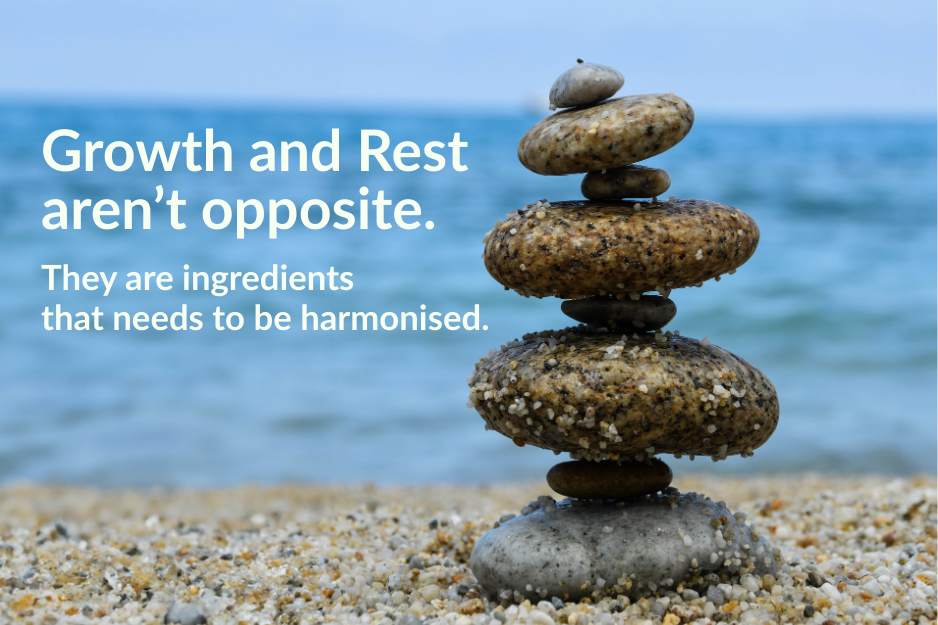
Self-care and boundary‑pushing aren’t opposites. They’re ingredients.
Think like a good cook: you don’t add more spice just because you’re anxious. You taste. You adjust. You control the heat. You practice restraint. You make a dish that fits the moment.
Try this once a day—five minutes, no perfection required.
Taste: What’s true in me right now—tired, anxious, energised, foggy, focused?
Heat: What deserves high heat today (one brave task), and what can simmer?
Subtract: What one small thing can I remove to make space—one meeting, one scroll trigger, one unnecessary “should”?
If you’re truly exhausted, “growth” might mean one courageous act: saying no, asking for help, admitting you can’t carry it alone.
If you’re comfortable but stuck, “self-care” might mean compassion—while still choosing a 10% stretch that builds confidence.
If you’re overloaded, the most responsible move might be subtraction: fewer commitments, fewer tabs in your mind, fewer “nice-to-haves” pretending to be necessities.
If you’re in a high-pressure season, recovery isn’t a reward. It’s part of training.
If you want the fuller framework—why “balance” breaks under pressure, how harmonising becomes a learnable craft, and how you can design a healthier pace for teams—click here to read the article: From Balance to Harmonising by Dr Ben Koh, Founder of Coach Masters Academy.
Here is a song, ” Rise Again”, produced by us to inspire you.
Click Here to Listen on Spotify or Click Here to Listen on Apple Music.
You can explore our award-winning, globally delivered coaching training program – Transformative Edge (TM). Click Here to learn more.