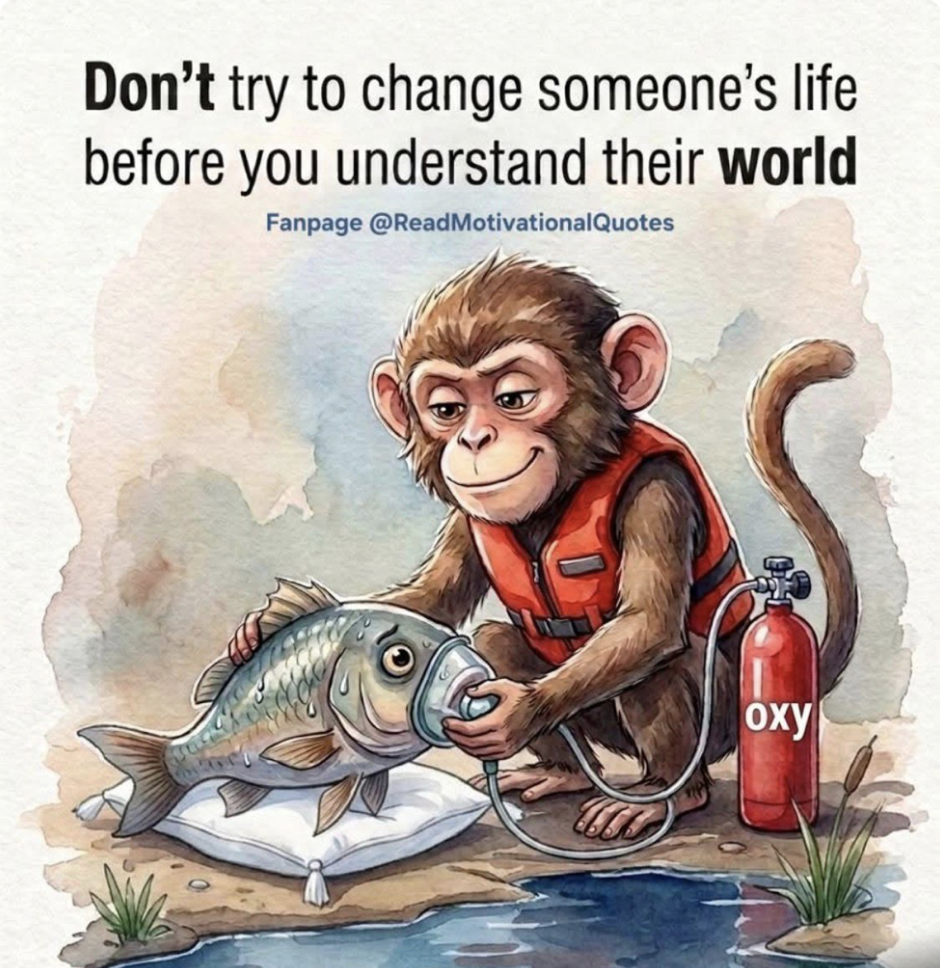
A Monkey sees a Fish thrashing in a shrinking pool after a flood. Wanting to help, it lifts the Fish out of the water and places it on a dry branch. The Monkey acts with care. The Fish dies.
The mistake is not a lack of compassion. It is a failure of understanding. What looked dangerous to the Monkey was the very condition that made life possible for the Fish.
That mistake is more common than we think.
We see it in parenting when advice comes before understanding. We see it in leadership when pressure is applied to someone who actually needs safety. We see it in relationships when one person offers solutions while the other is still trying to feel heard. And we see it in coaching whenever someone tries to fix the visible problem without understanding the inner world that gives it meaning.
That is why transformational coaching begins in a different place.
Coaching happens in conversation. People do not simply describe their experience in language; they reveal how they are organising it. They show us what they notice, what they ignore, what they fear, what they assume, and what they believe is possible.
A person says, “I always end up here.” That may sound like a description, but it may also be a rule they have come to live by.
Someone says, “I have no choice.” That may sound like a fact, but it may reveal a collapsed sense of agency.
Someone says, “If I slow down, everything will fall apart.” That may sound practical, but it may actually be an old survival pattern still shaping the present.
This is where skilled coaching differs from ordinary helping: it examines how people make sense.
We are not good observers of ourselves, especially when we are the storytellers.
This is where predictive processing offers a useful lens. The mind is constantly anticipating what things mean and what is likely to happen next. We do not simply take in reality as it is; we interpret it through patterns we have already learned.
That is what the Monkey does. It fears water, so it reads water as danger. It values dry land, so it reads the branch as a sign of safety.
We do the same thing.
A leader who values decisiveness may misread reflection as weakness.
A parent who values discipline may misread sensitivity as fragility.
A coach who values action may misread hesitation as resistance.
In each case, the risk is the same: we project our model onto someone else and call it help.
This is where epistemic humility matters.
Put simply, epistemic humility means holding our interpretation lightly enough to admit that we may not yet understand what is really happening. It is the discipline of recognising that our first reading may be incomplete, premature, or wrong.
This is not passivity or lack of confidence. It is maturity in practice. Without it, we rush in with certainty. We assume we know what the other person needs because we have already translated their experience into our own terms. We prescribe before we understand. We rescue before we see.
With epistemic humility, we slow down enough to ask better questions.
What if this behaviour makes sense within a reality I do not yet understand?
What if this “resistance” is actually protection?
What if this confusion is not weakness, but the beginning of change?
Those questions create the possibility of wiser intervention.
A transformational coach does not focus only on the event being described. The deeper task is to understand the structure of meaning beneath it.
That means listening for assumptions, identity positions, recurring fears, and the future the person is already predicting. It means noticing where language becomes rigid, where contradiction signals strain, and where a new interpretation is trying to emerge.
Real transformation begins when the client starts to see how their own thinking has been shaping their experience.
What felt like truth may turn out to be an old expectation.
What felt like incapacity may be a learned rule.
What felt fixed may simply have gone unexamined for too long.
At that point, change is no longer just a matter of motivation or willpower. The person is not merely pushed toward action; they begin to see differently, and from that new seeing, different action becomes possible.
The lesson of the Monkey and the Fish is not “do not help.” It is “do not help too quickly.”
Good intentions are not enough. Care without understanding can still cause harm. Action without insight can move someone away from the very conditions a person needs in order to grow.
Transformational coaching asks more of us. It asks us to listen beneath the surface, question our own assumptions, and understand the world another person is living inside before we try to change it.
And sometimes, when we listen deeply enough, we discover that the issue is not only a habit to fix or a decision to make. Beneath it are deeper human questions: meaning, freedom, responsibility, identity, and the kind of life a person is actually participating in. That is where real coaching begins to engage the whole person.
If this perspective resonates with you, continue with the article by Dr Ben Koh, “Existential Approach to Engage the Whole Person,” where we explore how coaching can move beyond correcting symptoms to working with the deeper structures that shape how a person lives, chooses, and changes.
Real transformation does not begin when someone is pulled out of the water. It begins when they understand the world they have been swimming in — and the life they are now being called to live.
This works because it bridges naturally into the linked article’s core themes: coaching beyond technique, attention to the “issue beneath the issue,” and a deeper engagement with meaning, freedom, responsibility, identity, and generative change.