


What Would an ICF Credential Add?

What Would an ICF Credential Add?

Written by Dr Ben Koh, MCC | Founder, Coach Masters Academy
Two-Time Global Top 50 Coaches Honoree
Since 2020, he has helped more than 100 ICF Credential Coaches successfully earn the MCC Credential.


You have completed your coaching education. You have practised, received feedback and passed an assessment. Your clients are making progress.

Why pursue an individual ICF credential?

The answer is not simply professional recognition. People learn to coach for different reasons: to lead teams better, develop colleagues, work more effectively with people, build a coaching practice or deepen their own capability.

If you have already obtained your certification as a Certified Professional Coach, why seek another form of recognition?

Because a helpful coaching conversation, demonstrated coaching competence, and a professional credential are different things.

A conversation may help someone reach a useful decision. An assessment examines whether particular coaching competencies were demonstrated. A credential confirms that a defined set of professional requirements has been met.

Each answers a different question.


What a credential recognises

An ICF credential shows that a coach has met recognised requirements for education, experience and assessment. It does not replace the ongoing work of learning, reflecting on practice and becoming more skilful.

It gives a coach a recognised way to show that their coaching has been prepared for, practised and assessed.

For some practitioners, that is enough reason to pursue it. For others, the question is whether coaching has become important enough in their work to warrant that level of commitment.


Four different pursuits

People undertake coaching education with different intentions.

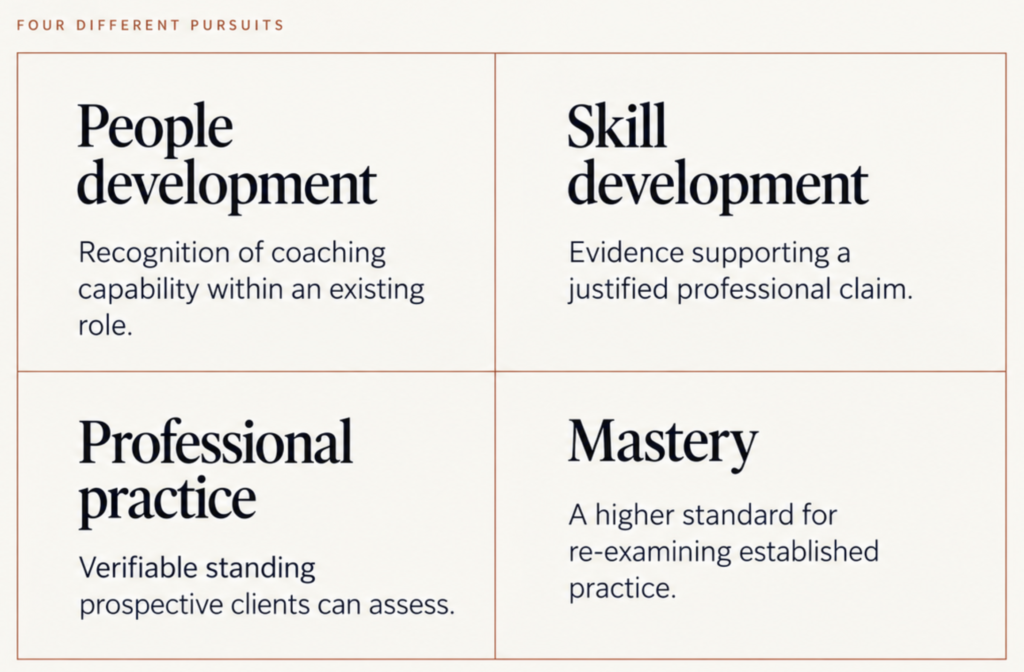
Four interests are especially relevant here. Some want to develop others within an existing role. Some seek to formalise a skill and practise it more reliably. Others intend to establish a professional coaching practice, while experienced coaches may be drawn towards increasingly demanding standards of mastery.

We will refer to these interests as the People Developer, Skill Builder, Practice Builder and Mastery Seeker. They are not four types of coaches or steps along a career ladder.

These pursuits offer four perspectives for examining the value of professional recognition.


The People Developer

A manager may use coaching to help a colleague think through a difficult decision. An educator may use it to build a learner’s independence. Neither necessarily wants to become a professional coach.

For People Developer, their focus is the other person’s growth.

Over the past decade, I have supported lawyers, educators and senior leaders in pursuing the ICF Master Certified Coach (MCC) credential- the highest level, where less than 5% hold this credential. They remained committed to their professions.

Because coaching had become central to how they led and developed others, and they wanted that capability examined and recognised with the same seriousness they brought to the rest of their work.

When coaching becomes central to how you practise your profession, what would it mean to have that capability recognised in its own right?


The Skill Builder

The Skill Builder wants to turn emerging or intuitive ability into dependable practice. That pursuit often begins long before an ICF credential is considered.

Rigorous education, mentored practice and assessment may already represent years of professional development. This is where coaching capability is developed, examined, and refined. The credential does not need to recreate that work.

Its contribution is more specific. It gives the practitioner’s achievement individual professional recognition beyond the programme in which they trained.

For the Skill Builder, the credential becomes a marker of achievement within a continuing commitment to developing their craft, rather than the means through which that craft is learned.

When coaching becomes a professional service, that evidence must also make sense to prospective clients.

If becoming a better coach is the real goal, what would a credential add?


The Practice Builder

The Practice Builder faces a different challenge. Before working with a coach, a prospective client cannot easily judge coaching quality.

Testimonials, referrals and previous experience can build confidence. But they do not give a complete picture of professional competence.

A credential provides another kind of evidence. It shows that a recognised professional body has confirmed that specified requirements have been met. This gives prospective clients a way to assess professional standing beyond the coach’s own account of their abilities.

A credential does not build a business. Trust still depends on the service, professional conduct and the value clients experience.

There is a meaningful difference between saying, “I can coach,” and making a claim supported by externally recognised evidence. Business development and credential pursuit can progress together because they address different aspects of professional readiness.

What can you show a prospective client beyond saying, “I can coach”?


The Mastery Seeker

The Mastery Seeker may have spent years coaching, learning and refining their judgement. Yet more experience does not necessarily mean greater competence. Neither does working with more senior clients.

For someone who wants to examine how far their coaching has developed, a higher credential offers a more demanding standard. It brings attention back to the coaching itself—how the practitioner listens, responds and works with the client today.

They may now work with more senior leaders, navigate more complex conversations or bring greater range and judgement to their coaching. The question is not whether their credential reflects the level at which they now coach.

A higher credential gives them a way to demonstrate that development against a more demanding standard. ACC, PCC and MCC are not distinguished simply by coaching hours. Each requires coaches to demonstrate a different level of coaching competence.

Has your coaching moved beyond what your current credential recognises?


When is a credential worth pursuing?

The four perspectives leave a more exact question: what would professional recognition make possible that education and experience have not already established?

Across these different purposes, pursuing a credential brings evidence of competence into relation with an external standard. This takes the question beyond confidence in one’s own ability. Confidence concerns what you believe you can do; accountability concerns what you can demonstrate against an accepted standard.

Credentialing is one form of accountability. Mentoring, supervision, reflection and ethical practice also matter. An individual credential makes a defined professional claim recognisable beyond the practitioner’s immediate circle.

This brings us back to the distinction between applying and pursuing. You apply for a credential when the requirements are met, and the timing is right. You pursue it when you decide that the professional standard matters enough to guide what you develop, demonstrate and maintain.

The credential recognises what has been established. The pursuit begins with deciding why that recognition matters to the work you intend to do.


I have composed a song that speaks of growth, purpose, commitment and the choice to keep becoming more capable in service of others. Those same themes sit at the heart of this article. An ICF credential is not merely a designation. For different practitioners, it can represent a commitment to develop people well, practise with greater skill, establish professional credibility or keep examining one’s craft.

Follow us on Spotify and Apple Music for many more inspirational songs. Search ” Coach Masters Academy “.


Every Chapter

[Verse 1]
I’m proud of what it took to come this far,
And all that I have learned along the way.
But there is more to me than what I’ve done,
And more ahead than I can see today.
There’s something in me reaching for what’s next.

[Chorus]
I take a step, then find my way,
Give all I have to each new day.
I want to see how far I’ll go,
There’s still so much I want to know.
I’m ready to try something new —
There’s so much more I want to do.

[Verse 2]
With every choice, I come into my own.
I’m learning I can do more than I knew.
What seemed so far away is closer now.
I give my best to what I choose to do.
I’m ready now to see what I can be.

[Bridge]
I’m proud, but I’m not finished yet.
There’s more I want to do and give.
And now I’m ready —

[Final Chorus]
To take that step, to find my way,
And give my all to each new day.
Each chapter helps me learn and grow,
I’m stronger now, and it will show.
I know there’s more that I can give —
I’ll build the life I want to live.

[Outro]
I’m growing stronger every day.
With all I am, I turn the page—
There’s still so much ahead of me.


Leave a Reply

Your email address will not be published. Required fields are marked *